

Small Site Accelerator: Unlocking Development Pipeline at Scale
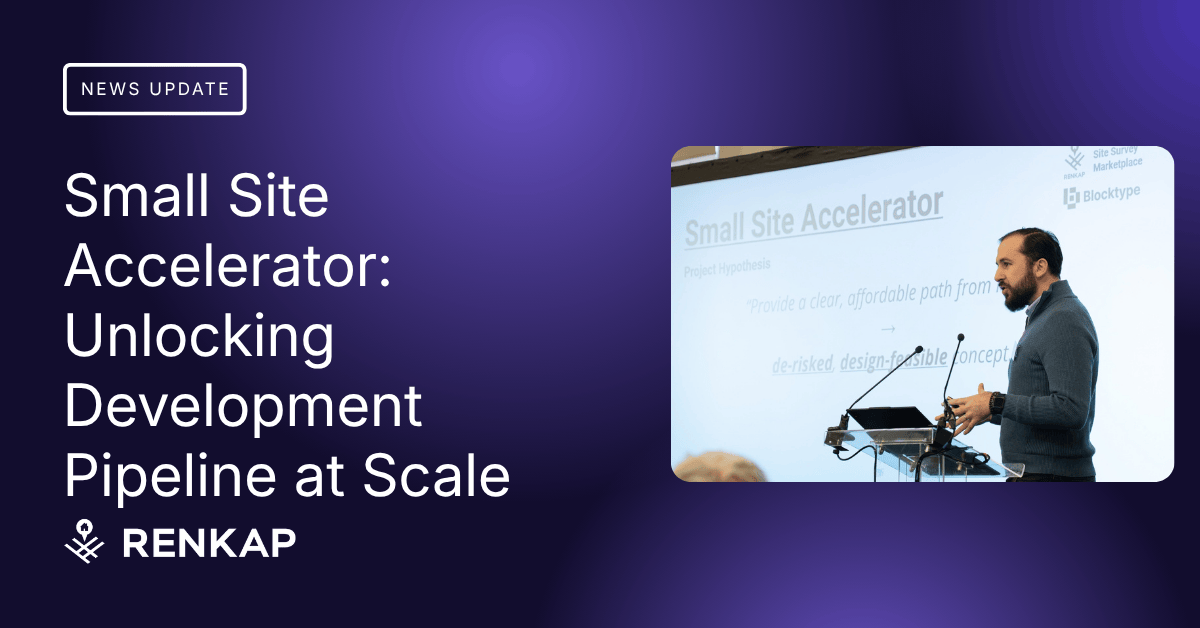
Before a council knows whether a small site can work, it has usually spent months and a lot of money on consultants. The Small Site Accelerator, built by RenKap and Blocktype, gets to that answer faster and for less. Lewisham, Lambeth, Bristol and Wigan councils tested it on 24 sites, through MHCLG and Geovation’s PropTech Innovation Challenge. With new Homes England funding for council capacity now open, here is what the pilot proved.
|
Key Result
|
Per site
|
|---|---|
|
Pre-planning time saved
|
4.3 months per site
|
|
Survey admin cost saved
|
£22k per site
|
|
Internal staff resource capacity gained
|
Over 90% per site
|
The Programme: MHCLG and Geovation’s PropTech Innovation Challenge
The Small Site Accelerator began in Round 5 of the PropTech Innovation Fund. The Ministry of Housing, Communities and Local Government (MHCLG) set up the fund to “transform the planning system and housing market by creating a thriving PropTech marketplace”. Its first four rounds, from 2021 to 2025, supported 77 councils across 114 pilots.
Round 5, the PropTech Innovation Challenge, was delivered with Geovation, Ordnance Survey’s innovation initiative. Its goal was to help deliver “the 1.5 million homes our country needs”. The £1.2m round selected 12 pilots across three problem statements: land data, small site deliverability and infrastructure certainty. RenKap and Blocktype’s pilot was on small sites.
MHCLG describes the small sites problem as “unlocking small site delivery by reducing investment risks and improving viability assessments for smaller developments”. RenKap’s Small Site Accelerator offering was built to answer that brief.
The Small Site Accelerator: What Our Round 5 Pilot Set Out to Prove
How a small site is assessed today
Before a council or SME developer knows whether a site can work, they need to:
- understand every potential site risk, from contamination and ecology to biodiversity net gain (BNG), utilities, bats and much more
- procure and manage every specialist, with nothing missed that could cause an expensive problem later
- test the site against local planning and unit types: how many homes fit, the tenure split and the gross internal area (GIA)
What the Small Site Accelerator does
The Small Site Accelerator pairs two platforms. RenKap lets you tender and procure the right surveys, with the right surveyors, at the right time allowing you to identify all the site constraints on one platform. Blocktype then gives you instant massing options for your unit types on that site i.e. how many homes you can fit, tenure types, accommodation schedules etc.
RenKap’s Constraint Plan links the two. RenKap builds it from the survey results: underground sewers, utilities, root protection areas and anything else that limits the developable area. Blocktype feeds it into its massing models, so every layout reflects the real site constraints.

The hypothesis
Our pilot project set out to “provide a clear, affordable path from raw site to de-risked, design-feasible concept”.
Put simply, the early, risky stages of development do not need to be so costly, slow and expert-driven. A council or SME developer should know a site’s chances before spending a lot of money and time which could be abortive. We want to remove this barrier to help unlock more housing pipeline at scale.
How We Tested It: Four Councils, 24 Sites, Six Months
Lewisham, Lambeth, Bristol and Wigan councils each put six sites through the Small Site Accelerator, making 24 sites in total. The pilot ran for six months and finished in March 2026.
We interviewed every council at the start of the pilot to understand how they currently manage this full process and again at the end after using RenKap and Blocktype.
We compared the outputs of the Small Site Accelerator with their traditional methods in time and cost. We did this at four stages: survey tender and procurement, live survey management, reviewing survey reports, and massing and feasibility.
What We Proved
Here is a summary of the detailed comparison on a per stage basis:
|
Stage
|
Time
|
Cost
|
Difference
|
|---|---|---|---|
|
Tender and procurement (RenKap)
|
18 days down to 30 minutes per site
|
£5,918 down to £22 per site
|
267 times cheaper per site
|
|
Live project management (RenKap)
|
2 days down to 1 day per site
|
£2,054 down to £545 per site
|
4 times cheaper per site
|
|
Reviewing survey reports (RenKap)
|
11 days down to half a day per site
|
£3,965 down to £166 per site
|
24 times cheaper per site
|
|
Massing and feasibility (Blocktype)
|
15 days down to 3 days per site
|
£10,000 down to under £500 per site
|
20 times cheaper per site
|
In summary we proved the following results:

What the councils said
Here is what the pilot councils said, in their own words.
Final Presentation to MHCLG
At the end of the pilot, Gonzalo Marquesini FRICS, RenKap’s founder, presented the Small Site Accelerator to MHCLG. Watch the full presentation below.
The Opportunity: Taking the Small Site Accelerator National
Now picture every council in England with a clear, affordable path from raw site to de-risked, design-feasible concept. The funding to build that capacity is now open. On 21 September 2026, the government announced a £21.8m boost to the Council Housebuilding Support Fund (CHSF), run by Homes England. It helps councils “build the skills, capacity and partnerships needed to develop strong bids for the Social and Affordable Homes Programme (SAHP)”. Bidding closes on 2 November.
The Small Site Accelerator shows what that capacity can look like in practice. In the pilot, council teams gained over 90% in internal staff resource capacity per site. We cover how to build capacity that outlasts the grant in our guide to the Council Housebuilding Support Fund.
Councils can buy RenKap now through G-Cloud 15, where a direct award can close in days.
If you’d like these results on your sites, get in touch.

Get Multiple Survey Quotes Instantly
RenKap connects you with vetted UK surveyors across all survey types.
Upload your site and receive multiple like-for-like quotes instantly. Completely free.